Memory (RAM) is one of the most important parts of a quiet, reliable PC or server. That’s why we don’t just “drop in”
whatever modules are cheapest that day. Every system we ship uses high-quality memory that’s been carefully chosen,
validated on the motherboard we’re using, and then fully tested before it leaves our lab.
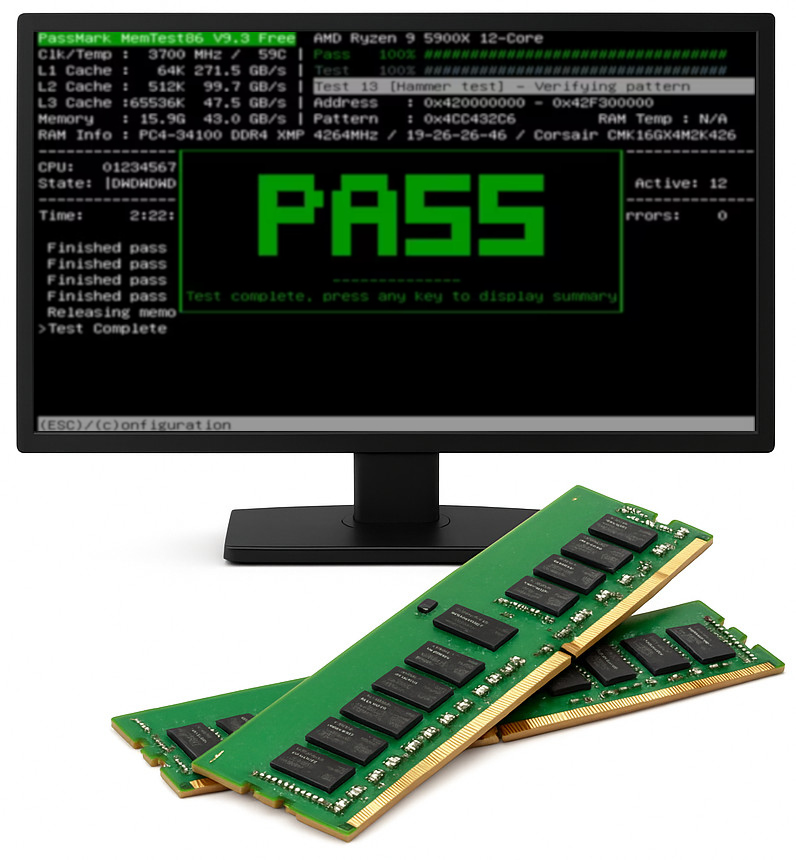
Every system is validated with MemTest and extended burn-in so your memory is stable under real operating conditions.
Testing
How We Test Your RAM
Every system goes through a dedicated memory validation stage as part of our burn-in process:
MemTest validation: We run industry-standard MemTest to check for bit errors, addressing issues, and stability problems that often don’t show up in a quick boot test.
Full system burn-in: After MemTest, we stress the entire system (CPU, memory, and more) under sustained load to ensure your RAM is stable at operating temperature, not just when it’s cold.
Our standard: If a module shows even a hint of instability, it doesn’t ship.
You get memory that has already survived the kind of testing most systems never see.
Compatibility
Only High-Quality Modules from the QVL
We only use memory from reputable brands and part numbers that appear on the motherboard’s
QVL (Qualified Vendor List) whenever possible. The QVL is the board manufacturer’s list of modules they’ve
actually tested and certified as compatible at specific speeds and capacities.
Brand-name modules only: No generic, no mystery ICs, no “whatever was on sale.”
Matched to the motherboard: We cross-check capacity, speed, and ranks against the QVL to avoid hidden compatibility issues.
Configured for stability first: XMP/EXPO or DOCP profiles are only used when they’re proven stable on that platform; otherwise we choose the most reliable settings.
The result is memory that not only looks good on a spec sheet, but actually runs reliably on your exact configuration.
ECC
ECC vs Non-ECC Memory (Server & Workstation Builds)
For server and some workstation builds, we often recommend ECC (Error-Correcting Code) memory:
ECC RAM
Can detect and correct single-bit memory errors on the fly, improving data integrity for 24/7 servers, virtualization hosts, and storage systems.
Non-ECC RAM
Standard on most desktops and gaming systems. It offers excellent performance but doesn’t correct random bit errors.
ECC support depends on both the CPU and the motherboard. Where the platform supports it and the
system’s role justifies it (servers, NAS, business-critical workloads), we strongly favor ECC to maximize reliability.
DDR5
Why Fewer DDR5 Modules Can Be Better
With DDR5, more sticks of RAM doesn’t always mean faster. Modern CPUs have an integrated memory controller (IMC) that has
to drive all installed modules. When you populate four DDR5 DIMMs instead of two, many platforms will
automatically down-clock the memory speed to keep the system stable.
2× DIMMs instead of 4× DIMMs for the same total capacity (for example, 2×32 GB instead of 4×16 GB).
Keeping to the speeds officially supported by the CPU and motherboard when all slots are populated.
Real-world result: Two high-capacity DDR5 modules usually deliver higher effective performance and better stability than four smaller ones running at a reduced speed.
Goal
Our Goal: Quiet, Stable, Long-Lived Systems
Whether it’s a silent desktop, a fanless all-in-one, or a 24/7 server, our approach to memory is the same:
use high-quality modules, verify compatibility, and stress-test every stick before it ships.
That’s how we deliver systems that aren’t just quiet on day one, but reliable for years.
Quiet Insights
Newsletter
Get Quiet Computing Updates That Are Actually Useful
Short updates on new systems, availability changes, and practical buying guidance for real-world workloads.